
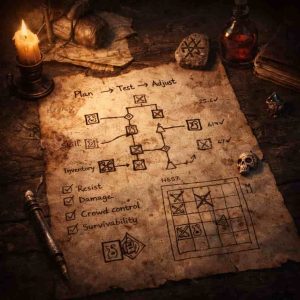
 When people talk about problem-solving in games, they often point to puzzles or strategy titles. But action RPGs can be just as demanding. Diablo II, released in 2000 and still played today, is a strong example. Beneath its fast combat and dark fantasy setting is a constant stream of small and large problems the player must solve, and even decisions like when to buy D2r items reflect that same cycle of planning, testing, failing, and adapting. The game rarely explains itself fully. Instead, it pushes players to observe, experiment, fail, and adjust. That process mirrors real-world problem-solving more closely than it might seem at first glance.
Learning Through Consequences, Not Instructions
Diablo II gives very little direct guidance. Early on, the game explains basic controls and then steps aside. Skill descriptions are brief. Enemy abilities are not clearly labeled. Drop rates and hidden mechanics are never spelled out. If a build fails, the game does not warn you. You find out when your character struggles or dies.
This design teaches players to learn from outcomes rather than from instructions. You invest points into a skill, test it in combat, and see whether it works. If it doesn’t, you adjust. This kind of feedback loop encourages careful thinking. Players learn to ask practical questions: Why did that fight go poorly? Was it positioning, resistance, or damage output? The answers come from observation, not menus.
Over time, players become more deliberate. They stop clicking unthinkingly and start testing ideas. That habit translates well beyond games.
Breaking Big Problems into Smaller Ones
At greater difficulties, Diablo II becomes punishing. Enemies hit harder. Resistances matter. Mistakes stack quickly. Progress often stalls, especially for new players. But the solution is rarely “play better” in a vague sense. Instead, players must break the problem down.
If a character keeps dying, the issue might be low fire resistance, weak crowd control, or poor hit recovery. Each of those can be addressed separately. You could swap one piece of gear. You could respec a single skill point. You could farm a specific area for runes. Progress comes from isolating variables and fixing them one at a time.
That approach mirrors effective problem-solving in work and life. Considerable challenges feel manageable when they’re reduced to smaller, testable steps.
Resource Constraints Force Creative Thinking
Diablo II is built around scarcity. Inventory space is limited. Gold has uses, but can’t solve everything. Powerful items are rare. Even skill points are precious, especially before respecs were added.
As a result, players are forced to make trade-offs. Do you carry more potions or keep that charm? Do you invest in defense now or save points for a late-game skill? There is rarely a perfect answer. Each choice closes off others.
These constraints push players to think creatively within limits. Instead of chasing ideal solutions, they learn to work with what they have. That mindset is valuable anywhere resources are limited, which is most places.
Pattern Recognition and Threat Assessment
Combat in Diablo II rewards players who scan situations. Different enemy types demand different responses. Some rush in. Others explode on death. Curses can flip a safe fight into a deadly one in seconds.
Good players learn to spot patterns fast. They notice which enemies appear together. They recognize danger cues and adjust positioning without stopping to think. This is not just a reflex. It’s trained judgment.
Over time, players build an internal library of scenarios. When something goes wrong, they don’t panic. They recall a similar situation and apply what worked before. That ability to assess risk and respond calmly is a core problem-solving skill.
Accepting Failure as Part of the Process
Diablo II does not protect players from bad decisions. Hardcore mode goes even further, deleting characters permanently on death. While not everyone plays that mode, the philosophy runs through the whole game.
Failure is expected. Builds fail. Characters stall. Gear choices turn out to be mistakes. The game does not soften the blow, but it also does not shame the player. You start again, this time with more knowledge.
This teaches a valuable lesson. Failure is not the opposite of success. It’s part of reaching it. Players who stick with Diablo II learn to detach emotionally from mistakes and focus on improvement instead.
Planning for the Long Term
Unlike many modern games, Diablo II is not built around constant resets or easy reversals. Skill choices matter. Some mistakes are expensive to undo. That forces players to think ahead.
Players learn to plan builds with future content in mind. They research synergies. They consider how a character will perform in later difficulties, not just the next zone. This long-term thinking changes how players approach decisions, both in-game and out. It rewards patience and foresight rather than impulsive optimization.
Why These Lessons Stick
Diablo II’s lessons endure because they are earned, not explained. The game does not lecture players about strategy or efficiency. It puts them in situations where thinking clearly is the only way forward.
That’s why players still talk about the game decades later. Not just because of nostalgia, but because it taught them how to think under pressure, learn from failure, and solve problems with incomplete information. Those skills don’t stay on the screen. They follow players long after the last demon falls.
